
President Cyril Ramaphosa cut a far more upbeat tone during his recent State of the Nation Address (SONA) – pointing to some green shoots in the South African economy. This will give some heart to entrepreneurs who have been sorely tested over the last few years.
Apart from an upbeat SONA, there was also a lot of positivity around the recently concluded annual Mining Indaba in Cape Town. Apart from lots of interest in the critical minerals story and the buoyant precious metals, there was some marginally positive data released by StatsA.
“Mining production increased by 2,5% year-on-year in December 2025. The largest positive contributors were iron ore (19,0% and contributing 2,7 percentage points) and manganese ore (40,4% and contributing 2,4 percentage points).”
It was less positive news from the Manufacturing data perspective:
“Manufacturing production decreased by 1,4% in December 2025 compared with December 2024. The largest negative contributions were made by the following divisions:
· food and beverages (-4,6% and contributing -1,4 percentage point);
· wood and wood products, paper, publishing and printing (-5,2% and contributing -0,6 of a percentage point); and
· basic iron and steel, non-ferrous metal products, metal products and machinery (-2,3% and contributing -0,4 of a percentage point).
The petroleum, chemical products, rubber and plastic products division was the largest positive contributor (7,5% and contributing 1,6 percentage points).”
Each month, the team looks to identify trends in the Working Capital and Capital raising space. Here are some of the trends we have identified for February 2026.
1. What are our digital channels telling us about entrepreneur capital needs?
As a digitally-led business, we lean into our digital channels to provide us with market insights and let us understand what our stakeholders are looking for.
These are some of the trends we have identified when it comes to our digital platforms in February 2026.
Primary search queries:
- Agro Processing Support Scheme
- Flexible Working Capital Loan companies for SMEs in South Africa
- Agro Processing funding
- Black Industrialist Scheme
The “Agro Processing Support Scheme” (APSS) / “Agro Processing funding” are popular search terms when it comes to our digital channels. Many South African entrepreneurs are attracted to the idea of grant funding for agriculture projects. We do however warn that there are some inherent challenges with the APSS that entrepreneurs should be aware of.
In terms of “Flexible Working Capital Loan companies” – this is another phrase we see quite often. As the funding landscape for SMEs is adapting, entrepreneurs are looking for flexibility when it comes to their funding partners. We unpack this in a recent blog post here.
Our most popular pages in February:
- Black Industrial Scheme information page
- Why fast finance is critical for South African entrepreneurs
2. Factoring for media companies
This was actually a trend picked up by our Investor Communications business over the last few months where we have seen a rise in enquiries from businesses looking for factoring options.
In essence, “factoring” is service where agencies, production houses, or publishers sell their outstanding client invoices to a third-party (factor) to receive immediate cash, usually 80-90% upfront. It solves cash flow gaps caused by long payment terms (30-90 days), allowing them to pay freelancers, cover production costs, and fund media buying.
3. LulaLend raises further capital to support SA entrepreneurs
Our partners from LulaLend have raised another R340m in funding to help support the small business ecosystem in South Africa. Using an innovative online business model and credit scoring algorithm, Lulalend provides fast and flexible business funding to SMEs and sole traders that traditional lenders often can’t serve.
The new funding has come from FMO – the Dutch entrepreneur development bank.
“This investment from FMO is a powerful endorsement of our mission to empower every South African SME to succeed. Access to capital remains the single biggest hurdle for small business owners; by bridging this gap, we aren’t just funding businesses, we’re fuelling the engine of our economy,” said Trevor Gosling, co-founder and CEO of Lula.
“Receiving this capital in local currency is a critical enabler. It eliminates the volatility of exchange rate fluctuations, allowing us to provide stable, predictable, and sustainable lending rates to our customers. Over the next three years, this capital will allow us to scale our impact exponentially, reaching thousands of additional entrepreneurs and helping them transition from survival to long-term resilience,” said Gosling.
Read more about the transaction here.
4. Looking for franchise expansion finance?
Franchising is a popular form of small business ownership in South Africa and our partners from Bridgement recently highlighted how they supported a KZN entrepreneur with R2m facility to buy another franchise.
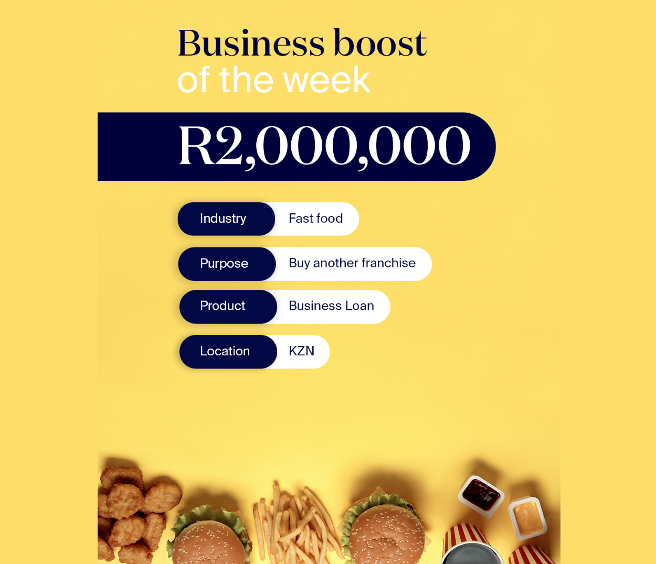
If you have similar working capital requirements, you can set up a free Bridgement account today,
Bridgement is an award winning South African fintech that offers a variety of funding lines for South African entrepreneurs including Business Loans, Lines of credit, Invoice finance and Trade Credit.
5. What does the interest rate outlook look like for South African entrepreneurs looking to access finance?
One of the factors holding up investment in the country are stubbornly high interest rates.
South African entrepreneurs will have taken heart from a recent survey by Bloomberg which suggests interest rates could be cut as many as 3 times in 2026.
Access to working capital and finance a challenge?
Raising capital is a specialist skill and it can be a time-consuming process for entrepreneurs who have to focus on running their core business.
Whether your business is looking for short-term working capital, strategic growth finance or you are looking to acquire another business, our team is hand to work with you.
Please do not hesitate to reach out to us to discuss your requirements.
